
 German (DE)
  English (US)
  Spanish (ES)
  French (FR)
  Hindi (IN)
  Italian (IT)
  Portuguese (BR)
  Russian (RU)
 Amanda Feindt sat in the fourth row during the Senate confirmation hearing of Defense Secretary Pete Hegseth. A U.S. Army major and former whistleblower who had submitted a letter supporting his nomination, Feindt listened as Hegseth spoke about troop readiness, military lethality, and protecting military families. Service members and veteran advocates around her wore shirts and hats bearing his name.
While Feindt sat in the Senate chamber, her 4-year-old son was in the military’s care, spending the day at the North Post Child Development Center at Fort Belvoir, in nearby Virginia. There, according to records reviewed by The Intercept, he was subjected to treatment that would leave lasting psychological effects.
It took a year for Feindt and her husband to figure out what it was.
In a series of interviews with The Intercept, Feindt described a grueling pattern of obfuscation in which military officials refused to answer questions about her child’s treatment, directed her to file public records requests, and claimed not to have the attendant evidence — then produced it months later. Military experts characterized these delays as part of a pattern in which the institution seeks to slow-walk and minimize findings of child abuse or mistreatment to decrease reputational damage. Over a year of persistent requests, Feindt and her husband finally pieced together a picture of their child’s treatment during at least two instances that January: The day of the hearing, when staff mocked and harassed the 4-year-old, and a few days earlier, when surveillance video showed them stepping on his feet and pinning his legs under a table. Local authorities later classified the treatment as child abuse.
“My son barely has the words to describe what happened to him,” Feindt told The Intercept. “You can see it in the video — they’re screaming while the abuse is taking place.”
Three other military families whose children suffered maltreatment in U.S. Army facilities described similar roadblocks. Parents who sought surveillance footage in other abuse investigations described receiving heavily redacted videos, incomplete clips, or footage with audio removed.
“This is a standard tactic in administrative cases,” said Ryan Sweazey, a retired Air Force officer and former inspector general. “They tell you the investigation is done, and if you want to challenge it, you have to file a FOIA request. The report then comes back heavily redacted months or years later.”
That’s what happened to the Feindt family: Army officials allowed them to review only a limited portion of the footage and would not provide copies of the video. While they watched, Feindt and her husband recorded audio and later described the scenes in a memorandum to Defense Department officials, both of which they shared with The Intercept. When the family sought additional footage and records, Feindt said officials directed them to file a Freedom of Information Act request before saying the remaining footage had been deleted after review.
According to Feindt’s memorandum, three staff members watched the teacher pin the 4-year-old’s legs and mock him without intervening. The footage then shows the teacher yanking the child upward by his clothing, grabbing him by the wrists, and pushing him out of camera view, Feindt and her husband write. In the audio the family shared with The Intercept, a child Feindt identified as her son can be heard screaming for the teacher to stop.
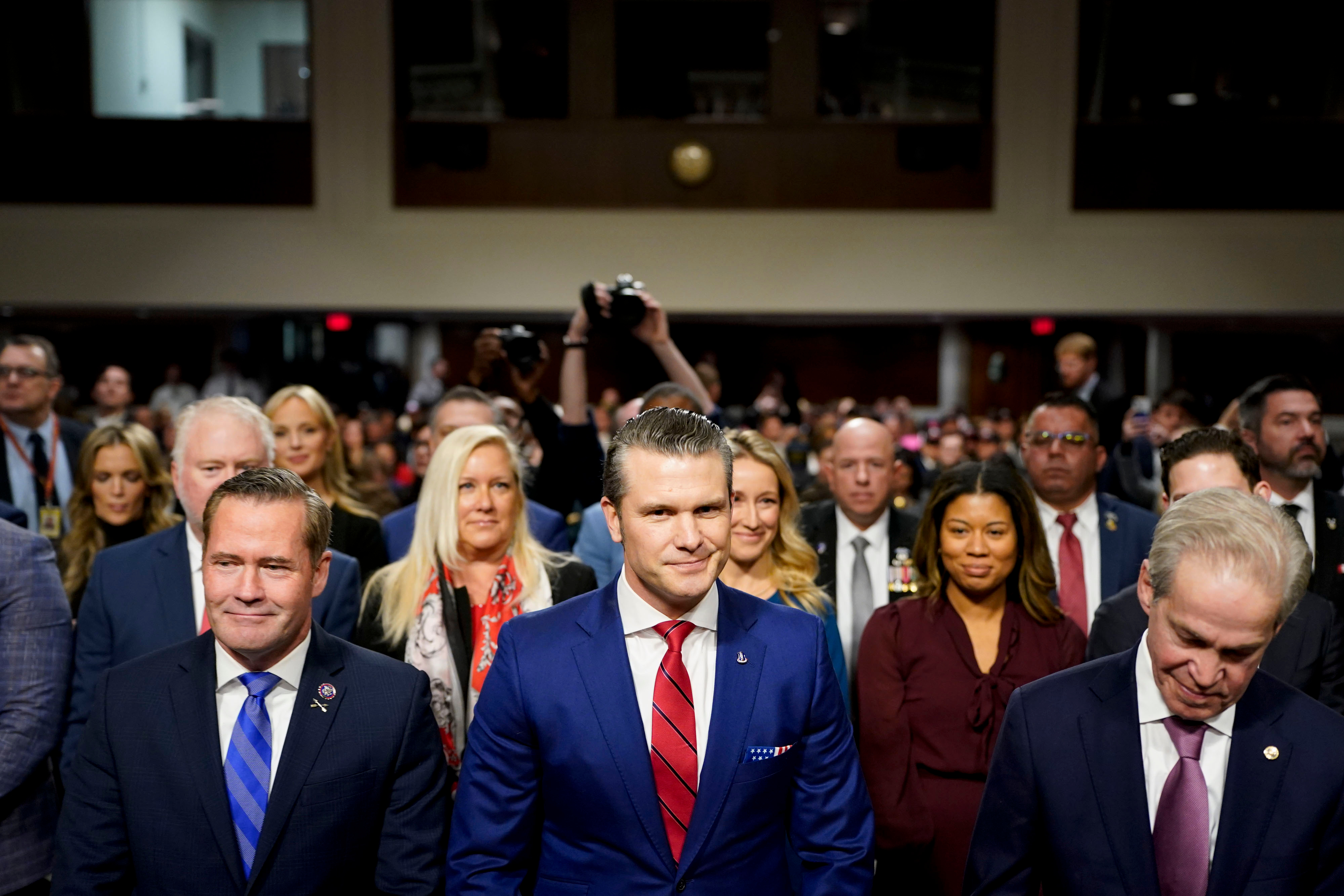 Pete Hegseth arrives for his confirmation hearing before the Senate Armed Services Committee in Washington, D.C., on Jan. 14, 2025. Photo: Kent Nishimura/Bloomberg via Getty Images
 Accusations of child abuse in the Army are handled through a quasi-judicial body known as the Incident Determination Committee, or IDC, which operates without many of the safeguards found in civilian courts. These panels can include social workers involved in the underlying case, members of the chain of command, or personnel with limited subject-matter expertise. The committee applies a “preponderance of information” standard that experts say can produce conclusions at odds with civilian investigators reviewing the same evidence.
Once the committee reaches a determination, parents are typically not allowed to review how the decision was made. Proceedings occur behind closed doors, with no transcript, evidentiary record, or opportunity for cross-examination available to families or attorneys.
“It’s one entity acting as judge, jury and executioner. There is no real due process, and there are almost no checks and balances,” said Sweazey.
The Feindt family was left unsure why their IDC did not substantiate abuse claims despite medical concerns and video evidence reviewed by investigators. Feindt tried to attend the committee’s hearing, but her request was denied. Afterward, she sought additional CCTV footage from the daycare, but Fort Belvoir officials told her the case was closed and she would have to file a FOIA request.
The system overseeing military child care centers is so fragmented that even grieving parents struggle to determine who is responsible when something goes wrong, said Jason Degenhard, a retired Army master sergeant who served in special operations. In 2012, Degenhard’s 4-fmonth-old son was in the care of the child development center on Pope Air Force Base (which today is part of Army base Fort Bragg) when a caregiver placed him on his stomach for tummy time, propped him against a rolled blanket, and left the room, as reported by WRAL News in Raleigh, North Carolina.
The infant’s muscles were not developed enough to support his weight, and he suffocated, causing catastrophic brain damage. The baby, named Sonny, was removed from life support days later.
“If you are a new parent trying to figure out how these centers are doing, you really do not have anything to go off of,” Degenhard said. In his telling, his chain of command supported the family immediately after Sonny’s death, but he remained troubled by what he described as limited institutional accountability afterward. Although the center was located on Pope Air Force Base, it operated under Army garrison authority, and Degenhard said the overlapping bureaucracies often left the family unsure who had the authority to provide answers or accept responsibility.
After federal prosecutors declined to pursue criminal charges, the Degenhards settled a wrongful death lawsuit against the federal government. Their emotional distress claims were dismissed.
“The heartbreak goes beyond the personal,” said Degenhard, who is still suffering from grief 14 years later. “The professional heartbreak is the lack of accountability, the lack of communication, and the lack of supervision.”
Feindt’s son became fearful and mistrustful of adults, regressed in potty training, and developed nightmares after Hegseth’s January 2025 confirmation, she told The Intercept. The family transferred him to another daycare, where Feindt said he struggled to adjust and accumulated roughly 20 behavioral incident reports in his first month, prompting administrators to bring in trauma specialists for support. His doctors said his symptoms resembled post-traumatic stress.
Army internal documents and communications acknowledged that supervisors watched her son being mistreated but did not intervene; no mandatory reporters documented the incident; and the parents were never notified. The conduct aligns with the Defense Department’s criteria for emotional maltreatment of a minor, but the Army IDC refused to classify the child’s treatment as abuse.
“For 15 months, the military told us this didn’t meet criteria,” Feindt said. “They made our lives a living hell.”
More than a year after the incident, in March 2026, Fairfax County Child Protective Services substantiated the case as child abuse and neglect, according to information provided to the family and confirmed by The Intercept. The finding will remain on the caregiver’s record for seven years.
On May 1, Fort Belvoir Child and Youth Services sent a letter to parents acknowledging a “founded disposition of a child abuse allegation,” stating that one caregiver had been removed from the facility and another was in the process of being terminated.
Records reviewed by The Intercept indicate the conduct at the childcare center extended beyond a single confrontation involving Feindt’s son.
Investigative materials obtained through FOIA describe repeated incidents in which caregivers allegedly mocked, threatened, and harassed children inside the classroom. Investigator notes reviewed by The Intercept describe a caregiver tugging a child’s hair, lifting a child by the back of their shirt, roughly repositioning children during classroom activities, and swinging a broom at a child.
In November 2021, when Pete Hegseth was a co-host on “Fox & Friends Weekend” and Amanda Feindt was an Army major, a storage tank maintained by the U.S. military began leaking jet fuel into the drinking water supply at Joint Base Pearl Harbor–Hickam in Oahu, Hawaii. In what became known as the Red Hill incident, for the name of the fuel storage facility, about 20,000 gallons of JP-5 jet fuel contaminated drinking water for roughly 93,000 people, including members of the military and civilians. The Associated Press reported that about 6,000 people were poisoned.
Feindt and her family were among the military households exposed to contaminated drinking water during the Red Hill fuel leak. After developing severe gastrointestinal symptoms, the entire family sought emergency medical care. Her infant son suffered chemical burns after bathing; her husband underwent multiple medical procedures for ongoing complications; and her daughter later developed neurological issues that the family believes stemmed from the exposure. The Feindts were evacuated from their home, shuffled between seven hotels, and relocated across the country twice. Feindt, a former cancer patient, developed enlarged and suspicious cervical lymph nodes.
 Air transportation specialists at Travis Air Force Base, Calif., load bottled water to be shipped to Joint Base Pearl Harbor-Hickam, Hawaii, amid the Red Hill water crisis on Dec. 10, 2021. Photo: Grant Okubo/U.S. Air Force via DVIDS
 Feindt became a substantiated whistleblower and lead plaintiff in a lawsuit over the fuel leak, arguing that the contamination had upended her family’s health, finances, military career, and daily life. Hegseth was of the first national reporters to contact her about Red Hill.
“There was a lot of back-and-forth by email,” Feindt said, recalling that Hegseth knew her attorney and would write from his personal Gmail as he followed the case. “He would check in about Red Hill, and we would give updates to him and Fox. He always seemed like he would advocate for us as a reporter.”
“He always seemed like he would advocate for us as a reporter.”
In the four years since Feindt’s exposure at Red Hill, the family has managed more than 700 medical appointments, multiple surgeries, and long hospitalizations. The Army moved the family to Fort Belvoir so Feindt could enter the Soldier Recovery Unit, a program intended to support service members with complex medical issues.
When her son experienced abuse at the Fort Belvoir childcare center, Red Hill came back to haunt her.
Staff members for Secretary of the Army Dan Driscoll told Feindt they would not meet with her because of her association with the Red Hill litigation, which she believed had already concluded. (A federal court found the U.S. government liable for poisoning military families through the Red Hill fuel spill, but awarded substantially lower damages than plaintiffs sought.) She escalated the matter beyond Army leadership, going up to Stephen Simmons, deputy assistant secretary of defense for military community and family policy, who acknowledged Feindt’s concerns and indicated he was aware of the situation as it unfolded in messages reviewed by The Intercept.
Simmons referred The Intercept’s request for comment to the Pentagon’s public affairs team, which did not answer detailed questions.
Sweazey, who also runs a nonprofit that supports whistleblowers, said he believes Feindt faced retaliation after pressing the Army for accountability.
“Unfortunately, it appears to be retaliation, and it’s not rare,” Sweazey said. “The moment someone questions the institution, they can become a target.”
Experts say abuse allegations inside military childcare centers often move slowly, with limited transparency and strong institutional pressure to minimize failures.
“Burying cases like these is a matter of control and institutional survival,” said Maj. Gen. Dennis Laich, a retired Army officer and director of the Eisenhower Media Network. “Incidents viewed as leadership failures can damage careers.”
When a toddler named Evie Glick came home injured from the Ford Island childcare center in Honolulu in 2022, staff told her mother that Evie had tripped, fallen, and hit her head. Jennifer Glick, a special agent with the Army Criminal Investigation Division, accepted that explanation at the time.
The following year, Navy Family Advocacy officials informed the family that Evie may have been physically abused at the daycare after another military family, the Kuykendalls, raised concerns uncovered while investigating the abuse of their own daughter, Bella. The Kuykendalls later launched Operation Mei Mei, an advocacy effort pushing for greater transparency and accountability in military childcare centers.
When the Glicks sought details, records, and footage, they said they received few answers.
It wasn’t until nearly three years after Evie’s injury that Glick saw surveillance footage through Operation Mei Mei. She said the videos contradicted the explanation she had originally been given.
“We were lied to. The [daycare] never told us our daughter was abused,” Glick said. “My first question, being in law enforcement myself, was: Where is the investigation?”
“The moment someone questions the institution, they can become a target.”
Glick said the footage showed a caregiver grabbing Evie by the arm, pulling her to the ground, and making her head strike the floor — causing the injury that, years earlier, the family had been told happened when Evie fell. In another clip, Glick said, a provider removed Evie’s shoes and socks and threw them away while the 18-month-old cried and wandered the classroom for 16 minutes.
Glick later filed a FOIA request seeking additional footage. She said the material she eventually received was heavily edited, redacted, and stripped of audio.
“They told me I could only view it with a JAG officer present,” Glick told The Intercept, referring to a judge advocate general, or a military lawyer. “There were three clips, each less than 20 minutes long. It wasn’t the full footage I asked for.”
As Feindt was fighting for recognition of her son’s abuse, and unbeknownst to her, the North Post Child Development Center at Fort Belvoir lost its accreditation.
In July 2025, the facility failed to complete required renewal requirements, including annual reporting and coordination of a site visit, as The Intercept confirmed with the National Association for the Education of Young Children.
The Intercept asked Fort Belvoir this April whether the center had experienced any recent changes to its licensing or accreditation status, including suspension, probation, or revocation. Fort Belvoir Public Affairs responded that the facility’s “current licensing status has not been changed” but did not directly answer questions regarding accreditation or respond to related follow-ups.
“My number one problem is that [Army childcare centers] are not responsible or reportable to the state.”
Unlike civilian daycares, Defense Department child development centers are not licensed by the state where they’re located. Instead, they operate under DoD oversight, but DoD policy requires centers to maintain national accreditation standards.
“My number one problem is that [Army childcare centers] are not responsible or reportable to the state,” said Degenhard, the father whose infant died in Army care. “They follow their own compliance and standards.”
According to a summary circulated among parents following a May 14 Fort Belvoir Parent Advisory Board meeting reviewed by The Intercept, installation officials later acknowledged the center had lost accreditation and recently reapplied. Families had not been informed the facility had operated without accreditation for almost a year.
Families had not been informed the facility had operated without accreditation for almost a year.
Feindt said she first learned of the lapse from a former daycare employee and independently contacted the accrediting organization to verify the information before raising it with installation leadership. The issue was later discussed at the parent meeting, where officials acknowledged the loss of accreditation.
Feindt said she was relieved that the caregiver who abused her child had been fired. “But this is not just about our family,” she said. “It’s a serious indictment of a system that failed to protect military children.”
 Hegseth posted a photo of himself fist-bumping a child, captioned “This is our why.” “Well, if that’s the case,” Feindt said, “why aren’t we taking care of our military kids?” Screenshot: @secwar via Instagram
 “Leaders at all levels will be held accountable,” Hegseth announced at the confirmation proceeding Feindt attended in January 2025. “And warfighting and lethality and the readiness of the troops and their families will be our only focus.”
Since taking office, Hegseth has made the military’s killing capability and the restoration of what he calls a “warrior ethos” the defining themes of his tenure. He has ordered the elimination of diversity, equity, and inclusion programs across the Defense Department; repeatedly criticized what he describes as “woke” influences in the military; and personally intervened in a series of culture-war controversies involving military installations and schools. Critics argue those battles have consumed attention that could otherwise be directed toward long-standing quality-of-life issues affecting service members and their families.
Lawmakers like Rep. Jill Tokuda, D-Hawaii, are pushing for greater transparency through measures like the Military Child and Youth Program Abuse and Neglect Notification Act, which would require timely notification to parents and establish more consistent reporting standards across services when allegations of abuse arise. But experts say the military continues to struggle with accountability when abuse allegations emerge inside its own child care system.
“How can anyone be mission ready or focused on lethal force if the military, in my family’s case, literally poisoned my child and now I can’t take them to daycare because they were abused?” Feindt said.
For Glick, her child’s abuse fundamentally changed how she views military service and childcare inside the Defense Department.
“That affects readiness because people will walk away if they don’t feel their children are safe,” she said.
The Pentagon has shown it can respond quickly when controversies involving children attract national political attention. After parents complained and a flurry of right-wing press coverage erupted over a transgender teacher who wore an animal tail and collar at a Fort Bragg elementary school, Hegseth proudly announced the teacher’s firing within weeks.
Feindt said the speed of that response contrasted sharply with her family’s experience.
“It shows they can act quickly when something becomes politically important,” she said. “But when military children are actually being harmed, families are left fighting the system alone.”
More than a year after the incident involving her son, Feindt said she believes meaningful change will only come if military families and senior leaders speak publicly about what they have experienced.
She pointed to a photo Hegseth posted online showing him fist-bumping a child alongside the caption: “this is our why.”
“Well, if that’s the case,” Feindt said, “why aren’t we taking care of our military kids? Why do we have a system that protects itself instead of protecting our children?”




/https://i.s3.glbimg.com/v1/AUTH_08fbf48bc0524877943fe86e43087e7a/internal_photos/bs/2026/2/d/ahXI6IRKKsgCfZJLSm1g/unnamed-1-.webp)


:strip_icc()/i.s3.glbimg.com/v1/AUTH_59edd422c0c84a879bd37670ae4f538a/internal_photos/bs/2023/l/g/UvNZinRh2puy1SCdeg8w/cb1b14f2-970b-4f5c-a175-75a6c34ef729.jpg)
/https://i.s3.glbimg.com/v1/AUTH_08fbf48bc0524877943fe86e43087e7a/internal_photos/bs/2026/f/G/gGrBNJRwaydNM9Xc9HNQ/54966404065-a6a099d410-b.jpg)
:strip_icc()/i.s3.glbimg.com/v1/AUTH_08fbf48bc0524877943fe86e43087e7a/internal_photos/bs/2024/o/u/v2hqAIQhAxupABJOskKg/1-captura-de-tela-2024-07-19-185812-39009722.png)







Comentários
Aproveite ao máximo as notícias fazendo login
Entrar Registro