
 German (DE)
  English (US)
  Spanish (ES)
  French (FR)
  Hindi (IN)
  Italian (IT)
  Portuguese (BR)
  Russian (RU)
 When federal Immigration agents gunned down 37-year-old Minneapolis resident Alex Pretti on Saturday, their identities were almost completely concealed. They were mostly wearing civilian clothes, and masks obscured their faces. With authorities refusing to disclose their names and records, the agents involved in the killing have so far remained anonymous.
But there is one distinguishing characteristic that could help identify the man who first opened fire: the patches on the back of his vest. One is the state flag of Texas. Another appears to read “U.S. Border Patrol.”

Insignia like these have become a common sight as federal agents swarm U.S. cities to carry out the Trump administration’s anti-immigrant policies. When Jonathan Ross shot and killed Renee Good, a 37-year-old U.S. citizen in Minneapolis this month, his tactical vest was adorned with “Police” and “Federal Agent” patches. When a mob of officers created a civil disturbance in which Democratic Rep. Adelita Grijalva in Arizona was pepper-sprayed, many were wearing a distinctive red shoulder insignia, some with vest patches reading “HSI.”
Patches like these are often the only means to identify a federal officer’s agency or a particular unit within it. But amid mounting scrutiny of the Trump administration’s brutal tactics, government agencies are attempting to keep information about their personnel, operations, and even their uniforms under wraps – right down to the patches that officers wear.
So The Intercept built a guide of the official shoulder patches ICE uses for unit identification, as well as known insignias worn by U.S. Customs and Border Protection or CBP personnel and unofficial patches conveying personal or political messages that federal agents have been spotted wearing. It’s a step toward transparency that immigration authorities refuses to provide to the American people on its own.
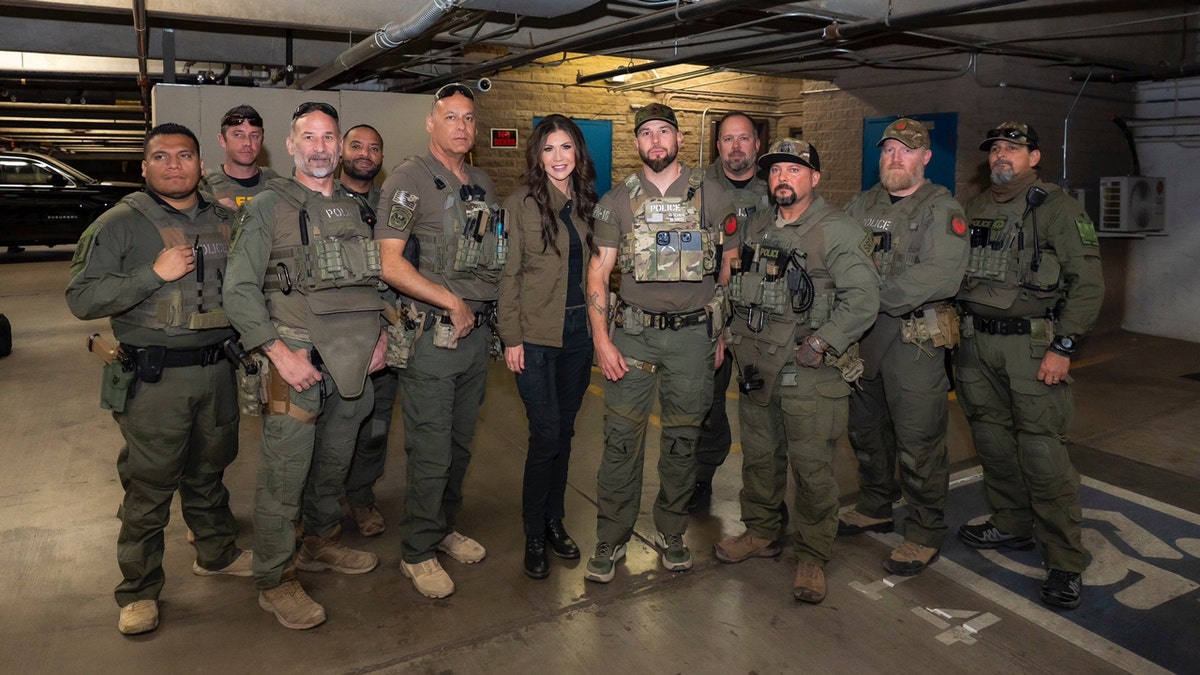
The most common patches are the least helpful. Many ICE agents affix to their vests or plate carriers vague patches reading “Police,” “Federal Agent,” or “Federal Officer.” Border Patrol agents often wear “Police” patches as well. Some common patches are also strictly fashion choices, such as earth-tone U.S. flags designed to blend into military camouflage.
But federal agents’ outfits are sometimes adorned with lesser-known acronyms that offer additional information. “ERO” is short for ICE’s Enforcement and Removal Operations, a unit tasked with the standard immigration enforcement process: identifying, arresting, and deporting immigrants. “HSI” stands for ICE’s Homeland Security Investigations unit, which formerly focused on transnational crimes, ranging from narcotics smuggling to cybercrime, but has been pressed into service as an anti-immigrant force.
 Patches worn by immigration authorities in northwest Washington on Sept. 29, 2025 ranged from vague, "Police Federal Officer," to specific, "ERO," indicating their role with ICE's Enforcement and Removal Operations unit. Photo: Jacquelyn Martin/AP
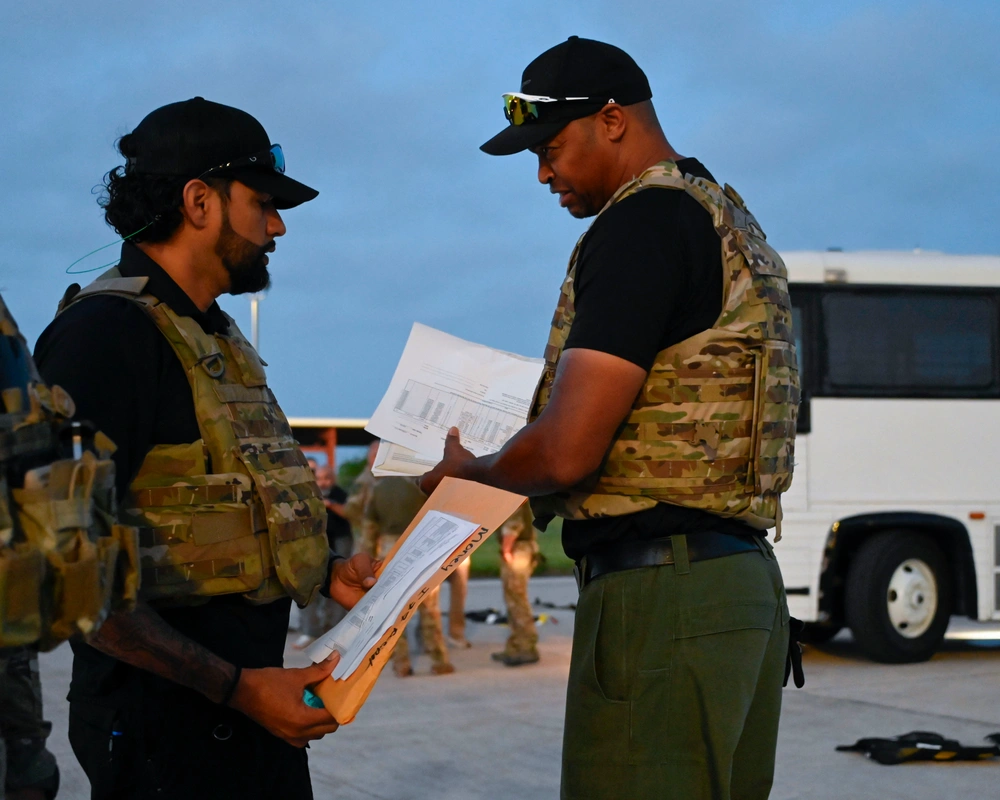
 CBP’s Border Patrol agents generally wear “U.S. Border Patrol” patches on their vests. Others sport “U.S. Border Patrol” or “U.S. Customs and Border Protection” patches on their sleeves. Specialized components of agencies, like CBP’s Air and Marine Operations unit, wear unique official patches. Others may wear unofficial morale patches designed to foster esprit de corps.
Last year, Cary López Alvarado, a U.S. citizen who was nine months pregnant, was harassed by a Border Patrol agent wearing a patch with the image of the Punisher war skull over a thin-green-line Border Patrol variant of the American flag. The iconic logo of the brutal Marvel Comics vigilante anti-hero from the 1970s, The Punisher, was inspired, in part, by the “totenkopf,” a skull-and-bones logo worn by the Nazi SS during World War II. The Punisher’s symbol has been embraced by members of the U.S. military and law enforcement personnel in the 21st century. CBP did not immediately return a request for comment about the patch.
 Left, a badge and patch from U.S. Customs and Border Protection's Air and Marine Operations unit; right, the so-called "Eyes" patch of CBP's San Angelo Air Branch. Credit: U.S. Customs and Border Protection
 Agents with the Border Patrol Tactical Unit, which specializes in high-risk operations like counterterrorism missions, often wear vests or shoulder patches that read: BORTAC. Some BORTAC agents have been spotted with a special patch on their plate carriers that features wings and a stylized starburst or compass over an American flag. (DHS spokesperson Tricia McLaughlin told NBC that the agents who killed Pretti included members of the Border Patrol Tactical Unit.)
Inside ICE, there are even lower-profile and less-documented, although official, insignia. Both ERO and HSI have Special Response Teams, tactical units devoted to higher-risk operations, like dealing with individuals with a history of violence or resisting arrest. There are 30 HSI offices across the country, including Miami which also has a HSI Caribbean attaché office.
Emily Covington, until recently an assistant director in ICE’s Office of Public Affairs, sent The Intercept images of 21 patches. “I gave you all the patches,” she said.
This wasn’t true, as a nameless ICE official later acknowledged. “[W]e are not going to spend time providing you with each and every patch,” he emailed from an official “ICE media” account. Covington said that ICE officials feared that The Intercept would use the patches to “dox people,” though she also dared The Intercept to pursue the story. “We hope that you go ahead and report,” she said. “Go for it.”
The Intercept compiled this set of images released by the Department of Homeland Security and open-source photographs.
ICE and DHS failed to respond to numerous follow-up questions dealing with insignia and patches submitted scores of times over a period of months as well as a request to speak with an expert on ICE uniforms and adornments. CBP acknowledged receipt of The Intercept’s questions but did not respond to them prior to publication.
 Some of the common patches worn by U.S. Customs and Border Protection and Border Patrol agents. Clockwise from upper left: Photo: Benjamin Applebaum/Released/DHS; Mikaela McGee/Released/DHS; Kevin Carter/Getty Images; Michael Siluk/UCG/Universal Images Group via Getty Images; Kevin Carter/Getty Images.
 The Department of Homeland Security provided The Intercept with images of 21 HSI special activities unit patches. The designs and aesthetics vary. HSI Arizona features a malevolent-looking rattlesnake coiled around an assault rifle. HSI Los Angeles includes a California condor clutching an automatic weapon in its talons. And HSI San Juan Puerto Rico’s image of SWAT officers appears to have been cribbed from sketches by the late artist Dick Kramer, the “father” of modern tactical artwork.


 An array of patches from ICE’s Homeland Security Investigations special activities units nationwide. patches Department of Homeland Security
 One notable absence from the patch collection provided by Covington is a shoulder patch worn by personnel from the St. Paul Field Office, where Ross works. (Ross is reportedly an ERO team leader and an SRT member.) The St. Paul office’s Special Response Team patch was spotted on the camouflage uniform of a masked ICE officer during a raid of a Minneapolis Mexican restaurant last year. The circular patch depicts a bearded Viking skull over an eight-prong wayfinder or magical stave – a Nordic image called a “Vegvisir.” The symbol has sometimes been co-opted by far-right extremists. ICE and DHS failed to respond to repeated requests for comment about the St. Paul patch.
Another patch missing from the images supplied by ICE is the Phoenix Special Response Team patch that DHS Secretary Kristi Noem was seen wearing on a tactical vest last year. The HSI Rapid Response Team patch was also missing from the official list.
The Intercept also inquired about various other patches found in online photos, including those posted on social media by the Enforcement and Removal Operations Newark field office covering New Jersey; the ICE Washington DC and Virginia field offices; and blurred out patches published by the ICE ERO Harlingen Field Office in South Texas. Neither ICE nor DHS responded to repeated questions from The Intercept about these patches.
In addition to official insignia, some federal agents have been spotted wearing seemingly unofficial patches to express personal or political predilections that DHS will not explain.
An ICE officer in Minnesota was spotted, for example, wearing a patch reading “DEPLORABLE,” a term some devotees of then-candidate Donald Trump adopted in 2016 after Hillary Clinton said half of his supporters belonged in a “basket of deplorables,” since they were “racist, sexist, homophobic, xenophobic, [and] Islamophobic.”
In November, after local reporting drew attention to the deplorable patch, Tanya Roman, the acting ICE communications director, said she would “look into” it. After The Intercept repeatedly asked for details, Roman replied: “Please contact DHS.” The Department of Homeland Security did not answer The Intercept’s questions about the DEPLORABLE patch.
 A masked U.S. Customs and Border Protection agent patrolled the halls of immigration court at the Jacob K. Javitz Federal Building in New York City wearing a Superman patch on August 19, 2025. Photo: Michael Nigro/Sipa USA via AP
 Over the summer, masked Customs and Border Protection and possibly ICE officers in Lower Manhattan were seen wearing Superman patches on their uniforms after actor Dean Cain, who portrayed the comic book character on television decades ago, announced his intension to join ICE. “We stand with Dean Cain,” one agent told amNY. Another said: “It’s just a patch.”
ICE, DHS and CBP did not return requests for comment on the patch or Cain’s status with ICE.
For further information on insignia, Covington directed The Intercept to a memo outlining ICE’s “approved HSI SRT uniform and authorized identifiers.” It notes that the “above-described patches which are not listed as optional shall be worn on all operations” but the sections dealing with those patches are redacted. Covington did not reply to questions about the redacted information. The guidelines also state that: “The use of military tabs/’rockers’ or any other type of patch not listed herein, is prohibited,” according to the guidelines, referencing specialized, mostly curved, patches common to both the military and motorcycle clubs.
In 2024, The Intercept shed light on a racist “Houthi Hunting Club” patch – photos of which were posted to and then disappeared from a Pentagon website – worn by members of the military.
Immigration authorities routinely cloak their secrecy in fears about the “dangerous doxxing” of their personnel and fight accountability and transparency at every turn. Over the summer, for example, Noem said that she was in communication with Attorney General Pam Bondi about prosecuting CNN for reporting on ICEBlock, a crowdsourced application that tracks ICE sightings.
Three women who put the home address of an ICE officer online were, for example, indicted in September in Los Angeles on conspiracy charges. “We will prosecute those who dox ICE agents to the fullest extent of the law.” said Noem. “We won’t allow it in America.”
Covington lobbed similar accusations at The Intercept. “Quite frankly, people here think you’re just doing it to dox people,” said Covington when The Intercept complained about ICE’s months-long foot-dragging on supplying promised images of patches.
While revealing the names of federal employees such as ICE officials is not doxxing, it’s unclear how this reporting would accomplish that. When asked how publishing a picture of a patch could be used to reveal someone’s identity – much less their phone number, address, Social Security number, names of their family members, or similar information – Covington failed to offer a coherent explanation. “I didn’t think it was possible for what has happened to our officers to happen, but it has,” she replied. “People are following our people home every single day.” Covington also did not explain how publishing the image of a patch would facilitate people following ICE officers to their homes.
ICE’s concerns about the public disclosure of patches are especially odd in light of all the unblurred photos and video footage of maskless officers available from an online database of agents and officials, publicly released mugshots of ICE personnel accused of crimes, images of agents from commercial photo agencies and the many photographs of unmasked officers posted by the War Department, DHS, and ICE or photos of agents with conspicuous and unique tattoos found on ICE’s own social media accounts.
On Sunday, before Border Patrol commander Greg Bovino was ordered out of Minneapolis by the Trump administration, a reporter asked if the agents who gunned down Pretti were on administrative leave.
“All agents that were involved in that scene are working, not in Minneapolis, but in other locations,” Bovino said. “That’s for their safety. There’s this thing called doxing. And the safety of our employees is very important to us, so we’re gonna keep those employees safe.”




:strip_icc()/i.s3.glbimg.com/v1/AUTH_59edd422c0c84a879bd37670ae4f538a/internal_photos/bs/2023/l/g/UvNZinRh2puy1SCdeg8w/cb1b14f2-970b-4f5c-a175-75a6c34ef729.jpg)


:strip_icc()/i.s3.glbimg.com/v1/AUTH_08fbf48bc0524877943fe86e43087e7a/internal_photos/bs/2024/o/u/v2hqAIQhAxupABJOskKg/1-captura-de-tela-2024-07-19-185812-39009722.png)








Comentários
Aproveite ao máximo as notícias fazendo login
Entrar Registro